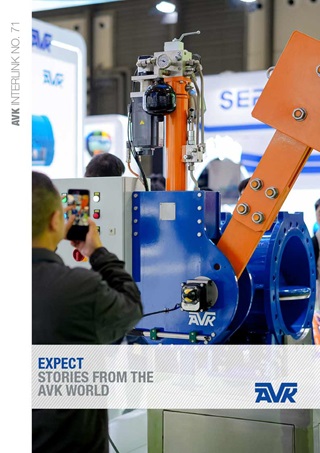
InterLink no. 71: Expect stories from the world of AVK 🌍
In the June edition of our InterLink magazine, you can read about some of our latest projects, initiatives and business highlights. Enjoy! 02-07-2026
The world is not on the verge of water bankruptcy – it has already gone bankrupt in terms of water.
This is according to a new report published by the United Nations University Institute for Water, Environment and Health.
As our water resources become increasingly polluted, as climate change intensifies, and as consumption patterns change – with larger cities in particular experiencing population growth and increased industrialisation – water supplies are coming under enormous pressure to deliver the required volumes to maintain a 24/7 service. The report states:
“Groundwater now provides about 50% of global domestic water use and over 40% of irrigation water, tying both drinking water security and food production directly to rapidly depleting aquifers. Around 70% of the world’s major aquifers show long-term declining trends. Excessive groundwater extraction has already contributed to significant land subsidence over more than 6 million square kilometers -almost 5% of the global land area – including over 200,000 square kilometers of urban and densely populated zones where close to 2 billion people live. In some locations, land is sinking by up to 25 centimeters per year, permanently reducing storage capacity and increasing flood risk. Surface waters are shrinking at scale. A growing number of major rivers now fail to reach the sea or fall below environmental flow needs for significant parts of the year. More than half of the world’s large lakes have lost water since the early 1990s, affecting around one-quarter of the global population that depends directly on them for water security.”
Water supplies that rely on meltwater from mountains are also facing challenges. The report states that:
“The world, in multiple locations, has already lost more than 30% of its glacier mass since 1970. Several low- and mid-latitude mountain ranges risk losing functional glaciers within decades, undermining the long-term security of hundreds of millions of people who rely on glacier- and snowmelt-fed rivers for drinking water, irrigation, and hydropower”.
Climate change does not only pose a challenge to water resources; it is also contributing to changes in consumption. During periods of drought, consumers naturally use more water. In order to maintain a 24/7 supply, the utility company must factor in a buffer, ideally 30% of the supplied capacity.
In 2023, the World Bank published a report addressing all national governments: ‘Do you know how much water you need now, in 10 years’ time, and in 20 years’ time? And do you know how much water you have available now, in 10 years’ time, and in 20 years’ time?’ I’d guess the answer is probably NO – we don’t know.
One thing that could be done, and something AVK can help with, is to plug the leaks in distribution networks worldwide. In this way, savings of up to 30% can be achieved initially – which is currently the average water loss rate. DMA technology and digitalisation are the way forward for reducing water wastage in the distribution network.
Have a great summer, enjoy the read, and thank you for reading.
Michael Ramlau-Hansen
Download